
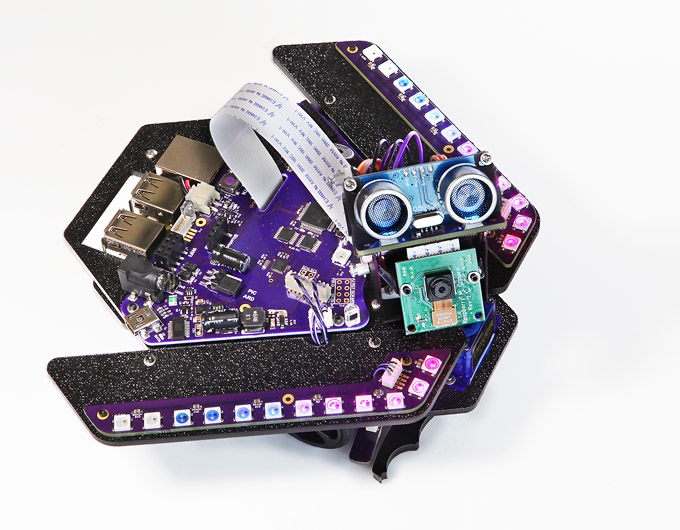
Spirit is a perfect starting point for students and hobbyists looking for an expandable and full featured robot platform. Whether you're new to coding or involved in serious robotics research, the Spirit Rover has something for you.
Hardware
Spirit Rover is outfitted with up to three different computing processors, built with high quality components, and fit into an iconic form factor that any tech nerd can appreciate! The plastic frame parts are made from semi-flexible ABS plastic while modules like the pan/tilt head assembly, motor/servo mounts, and connecting hardware are composed of stamped metal parts for maximum durability.
Sensors:
The Spirit Rover is jam packed with various on-board sensors to keep your projects fresh and evolving for years to come. It includes a 3-axis Accelerometer and a 3-axis Gyroscope to sense rotation and movement in all directions. It also includes an IR remote receiver and ambient light sensor.
Various headers are also present to allow interfacing of popular accessories like XBee, Bluetooth (HC-06) and WiFi (ESP8266).
Three Computer Boards in One Robot
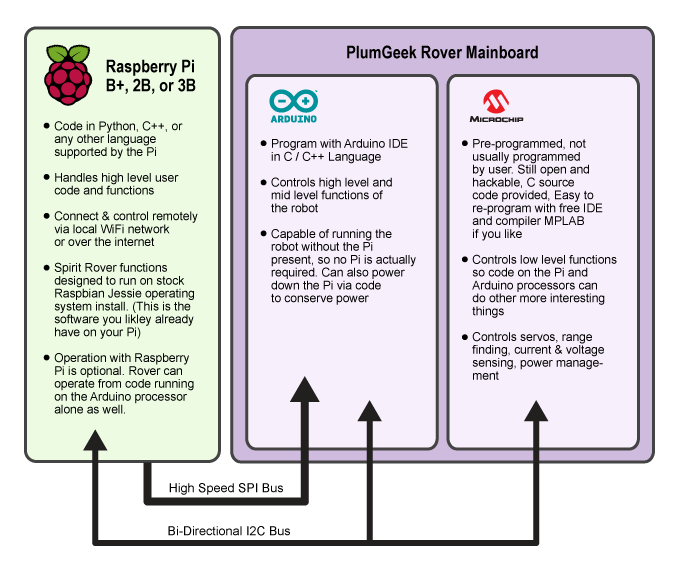
The Spirit Rover robot includes three different computation modules, just like many other advanced robots you'll find in the real world. Commands from the Pi can be sent to Arduino controller on the rover's main board using a set of simple and easy to use functions. The Arduino then in turn communicates automatically with a Microchip PIC processor which runs constantly in the background managing the low level hardware, doing things like setting the servo positions, measuring the ultrasonic rangefinder, measuring how much current the robot is consuming, etc.
● Raspberry Pi: Though it is optional, it is a powerful computer capable of doing many things at one time. The Pi can be used to perform complex tasks like computer vision which are computationally intensive.
● Arduino: Spirit Rover utilizes the same micro-controller as found on the popular Arduino UNO board. It takes care of the high and mid level functions of the robot and enables running the rover without the Pi present.
● PIC: A Microchip PIC processor handles the low level processing on the robot. It does things like sending pulse signals to the servos, reading light sensors, and managing the power system.
Software
The Spirit Rover combines the two most popular code learning environments: the Raspberry Pi, and the Arduino and allows you to design your own missions whilst learning to program in Python, C/C++, and Linux along the way. As your skills increase you can then hack the robot in any way you like to expand your knowledge and skills even further.

You can start with simple tasks like reading a light sensor and changing the color of on-board RGB "NeoPixel" style LED lights, then progress into more advanced topics. You can also learn about how robots use inertial navigation to find their way around, and computer vision to identify objects and obstacles. With Raspbian you can learn the inner workings of the Linux operating system and how to write your own code in Python and C/C++ languages along the way.
To learn more about the new Spirit Rover do visit their Kickstarter page and make a pledge if you are interested. $30,000 is required to take the new Spirit Rover into production.

0 comments