
Fast forward to 2016 over 10 million Raspberry Pi's have been shipped to customers all over the world. They even introduced the ridiculously cheap Raspberry Pi Zero retailing for a paltry $5 only!
In this article we will compare the best Raspberry Pi alternatives for those of you who need more bang for the buck.
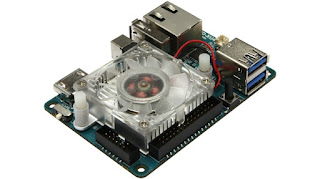
ODROID-XU4 is powered by ARM® big.LITTLE™ technology, where high-performance ARM CPU cores are combined with the most efficient ARM CPU cores to deliver peak-performance capacity, higher sustained performance, and increased parallel processing performance, at significantly lower average power consumption. The unit is powered by Samsung Exynos5422 Cortex™-A15 2 Ghz and Cortex™-A7 Octa core CPUs capable of running the latest Ubuntu, or Android KitKat / Lollipop depending on your choice. Keeping in mind about backward compatibility the XU4 is designed to be fully software compatible with XU3!
Verdict
The Odroid XU4 is an exceptionally powerful octa core , single board computer. When it comes to performance it is 2-4 times faster than Raspberry Pi 3, which is a huge bonus. It comes with on-board 2 G.B LPDDR3 RAM, 2x USB 3.0 support and native Gigabit Ethernet support . The only drawback with this board is the lack of a SATA port, and the fan can make a humming noise when the CPU load is high.
2. Beaglebone Black: “Boot Linux in under 10 seconds and get started on development in less than 5 minutes with just a single USB cable,” promises the BeagleBone website.
It is powered by TI AM335x 1GHz ARM® Cortex-A8 which is capable of supporting Sybian, Linux Minix, RISC OS, FREE BSD and OPEN BSD making it an ideal platform for development purpose. For those of you who are considering Android beyond handsets, project Rowboat enables Android on Beaglebone Black.
The BeagleBone Black measures 75mm x 75mm making it a highly compact and portable unit. Video ports include S-Video and HDMI port, it also has a GPU powered by Imagination Technologies, which provides 2D and 3D rendering as well. The device comes shipped with 4GB 8-bit eMMC on-board flash storage and 512MB DDR3 RAM. BeagleBone black is low cost and very much value for its money, The company claims that the Unit is targeted for coders and developers using Linux. The BeagleBone is guaranteed to boot Linux under 5 seconds, and start the process of development with in 5 minutes, making it highly time efficient and portable.
Verdict
All in all, BeagleBone black is a great alternative to Raspberry Pi and can be used for various different purposes. It is cheap and makes perfect sense for those who want a little bit more power, an easier set up, easier commercialization, or need to interface with many external sensors.
3. Banana Pi: The Banana Pi was designed to be an open source hardware platform and is often represented as a close alternative to the Raspberry Pi. It is a single-board computer manufactured in China. Around 10% larger than the Raspberry Pi in form factor, this board has various OS options available such as a Debian variant Bananian, Lubuntu, Fedora, Arch Linux and FreeBSD among others, as well as Android 4.2 and 4.4. You can even tun Raspbian OS but the CPU complies it with the requirements of the Debian Armhf port instead.
Coming to the hardware specs it brings some pretty familiar stats to the table. There are multiple Banana Pi boards available with varying specs, however we will focus on their latest offering the Banana Pi M64. M64 is powered by a 1.2 Ghz Quad-Core ARM Cortex A53 64-Bit Processor. It features 2GB of RAM and 8GB eMMC. It also has onboard WiFi and BT. On the ports side, the BPI-M64 has 2 USB A 2.0 ports, 1 USB OTG port, 1 HDMI port, 1 audio jack, and lastly a DC power port. Few models of the Banana Pi boards also support SATA 2.0 port.
Verdict
It is a good option for beginners who wants to build their own computers, and the versatility of the board certainly helps. While not quite as cheap as some other options, it’s near the bottom of the cost scale. Its unique selling point is its storage capacity that’s goes all the way to a maximum of 64 GB for SD card and a maximum of 2 TB through SATA port.
4. Intel Galileo Gen 2: Intel was lagging behind the IoT race and needed something to capture the market. So they decided to step into the market of SBC's with its previously introduced Intel Galileo single board unit. With fairly good specifications, the unit could only do so much in a market dominated by boards offering attractive prices with higher specifications. Intel needed to answer back, and Intel Galileo Gen 2 was a result of this brain storming at Intel. The new Galileo Gen 2 is powered by Intel’s Quark Application processor and runs on 32-bit Quark SoC X1000 processor with a clock speed up to 400 MHz.
What makes Galileo a formidable opponent is its software and hardware compatibility with Arduino environment. The use of Pentium architecture ensures both software and hardware compatibility with Arduino and its vast number of shields. This is a huge plus factor when you are developing a project which requires extensive hardware interfacing as well as respectable computing power. Apart from Arduino compatibility, it also features some unique on-board I/O slots and expansion ports that can enhance the experience to the next level.
Verdict
The Galileo is an impressive development platform for those interested in the Intel based Quark architecture which is familiar to a lot of users out there and thus can easily be put to use my many. On the other hand, the lack of audio and video output limits its flexibility when compared to the Raspberry Pi.
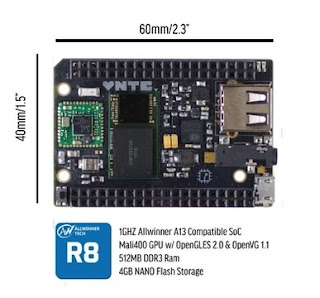
C.H.I.P. has built-in Bluetooth and Wi-Fi, so you won’t have to sacrifice a USB port. The computer runs at 1 GHz R8 ARM processor and hums along with 512MB of RAM, and 4GB of flash storage. It also has a full-sized USB port, and a composite video out, so it can work with older televisions.
Verdict
Considering the price tag of $9 we think C.H.I.P is the most interesting computer designed till date. This is mostly because it has on-board wireless capabilities, a more powerful processor than the Pi Zero, and on-board storage. In our view, this makes the Chip a more refined PC although it'll require fewer dongles to access all its capabilities. Shipping is expected to start around December, 2016.

All the above Boards are available at lowest prices at Fab.to.Lab (www.fabtolab.com) Do check them out..
ReplyDelete